Click to return to home page www.bluthner.co.uk
The Materials Used in Blüthner Pianos

The quality of Blüthner pianos has remained unchanged since Julius Blüthner founded the company in 1853. Being the highest quality instruments available today means that an extreme amount of care is used in selecting the raw materials.

The "just in time" philosophy in use by other manufacturers is not acceptable at Blüthner. As long as three years may pass from the first cut of wood to the final official inspection prior to delivery of the instrument to the customer. The Blüthner signature on each instrument is there to guarantee this high quality of perfection.


Wood is the primary material used in making a Blüthner piano and therefore it is most important that the proper selection is made that is suited for each function.

Various woods are obtained from many countries of the world. Each species requires different processes of curing. The hardwoods, from which the foundation of the instruments are made may require several years of air drying and maturing before they can be milled and formed into components.

Other important factors are the closeness of the annular rings and the condition of the soil and vegetation, which influences the mineral and electrolyte content.


Both pine and red beech are used in the main construction of Blüthner pianos. Each species serves a special need.

Pine

The pine preferred for Blüthner pianos grows on the sandy soils of the Mecklenburg and Moravian lowland plains. This species of pine is well suited for load bearing components and serves as material used in back posts and other areas that are under tensile stress.

Native Red Beech

Native red beech from Germany, known to be the best available in the world, grows in Germany's low mountain ranges. Red beech, the backbone of the piano, is subject to an intensive selection process even before the first cut is made. Because of its high degree of hardness and density, it provides and ideal abutment especially for tension joints and it is laminated into areas where it is necessary to hold screws.

Red beech is unsurpassed as a material for piano backs and inner rim construction where it must support the soundboard and bear the weight of the heavy iron frame. In cross beam construction, pine is laminated to a red beech core. This ensures great strength and holding power needed to secure the plate bolts and counter stress from string tension.

Spruce

Indeed, a special amount of attention is given the soundboard. Blüthner's special requirements for their soundboards make it often difficult to procure a quantity of quality spruce.

The wood must have a straight grain structure with close annular rings before it is considered to be resonance quality. Wood from trees that grow in the eastern Alps, the Bucovina in Rumania and the eastern Ural Moutains suit Blüthner's needs best. The trees, harvested in the winter, are felled by hand and loaded on sleighs, still pulled by horses from these remote areas. Handling and curing of the logs is carefully monitored: which being sawed into special quartered cants are put out to air dry. during this maturing process, which can last for several years, the closed cells of the wood are subject to a metamorphosis. A cytoplasm settles on the cell membrane and forms a stable unit which later results in conductin the string energy whcn struck by the hammer with little or no dampening loss as it is transformed into sound waves.

Consequently, only the best spruce, hand picked and assembled into a soundboard, suits Blüthner's requirements.

Felt

Apart from the timber requirements there are various forms of felt that can be found throughout the instrument, filling varying needs and requirements. Here, Blüthner must differentiate between two types of felts, woven and milled.

All felt used is of pure wool, which is subject to special cleaning and washing processes. it is then produced to different degrees of hardness and resiliency by the amount of milling and weaving given it. it is further processed according to a specific use by taking into account the fiber thickness and length. Felts must be made for the special uses in action centres, various bushings and bumpers, the dampening mechanism, pressure rests and hammers.


Steel

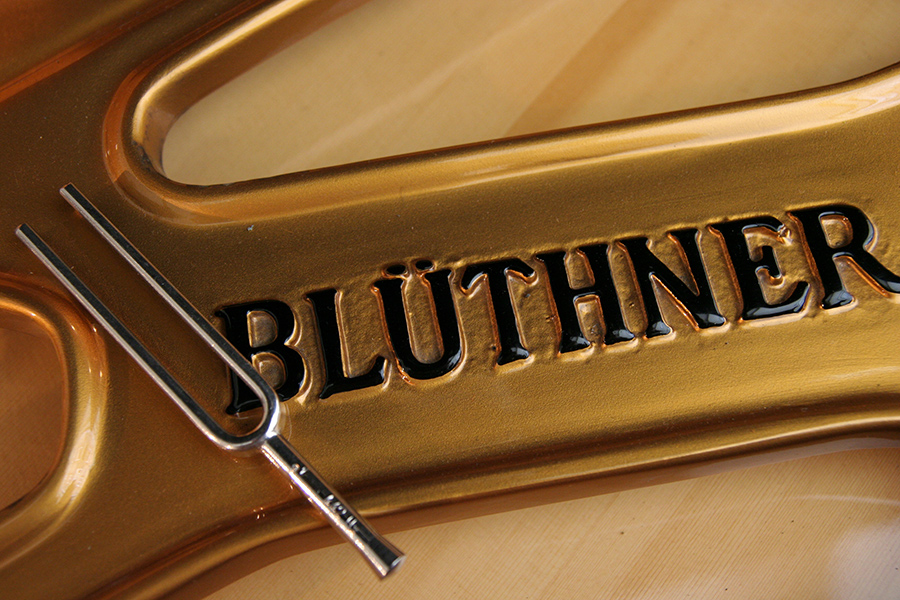
The iron frame is cash from a special form of steel. A high degree of precision and coordination is needed at the foundry because of the complex structure of the Blüthner frame. Careful monitoring during the foundry process assures that the cast frame will be acceptable. Various tests and chemical analyses for hardness are made during this time to be assured of a frame that will endure the stress placed on it string tension and the advancement of time. The crystalline structure layered with graphite produces a high degree of inner dampening to prevent the plate from producing its own natural unwanted vibrations. This is basic to the Blüthner concept of piano making.

The strings are manufactured from steel designed to withstand many pounds of tension when the piano is tuned to pitch. The steel is drawn through special dies and refined with a patented lead technique. A high degree of precision is maintained to assure that the string is the precise diameter needed to guarantee the clear and incomparable sound of Blüthner pianos. Bass strings are wound in the Blüthner factory. They are spun on hexagonal core wire in accordance to the tension needed and to assure that the copper winding will remain tight throughout the lifetime of the instrument. The strings are graduated at 25/1,000 mm and harmonically by their tension and length to the oscillating wave length of their acoustic structure. these factors ensure Blüthner's famous powerful and warm bass tone.


The keyboard is made of close grain spruce. Each key stick is layered with red beech for strength and durability at the pivot points and bushed with naturally tanned calfskin at the key pin mortises. This guarantees that stability will exist for more than one hundred years. The exposed part of the key is covered with acrylic material that accommodates the pianist's sense of touch. Special coverings can be request of fossil tusk materials. Sharps are solid ebony. A rosewood-ebony combination can be requested, also.


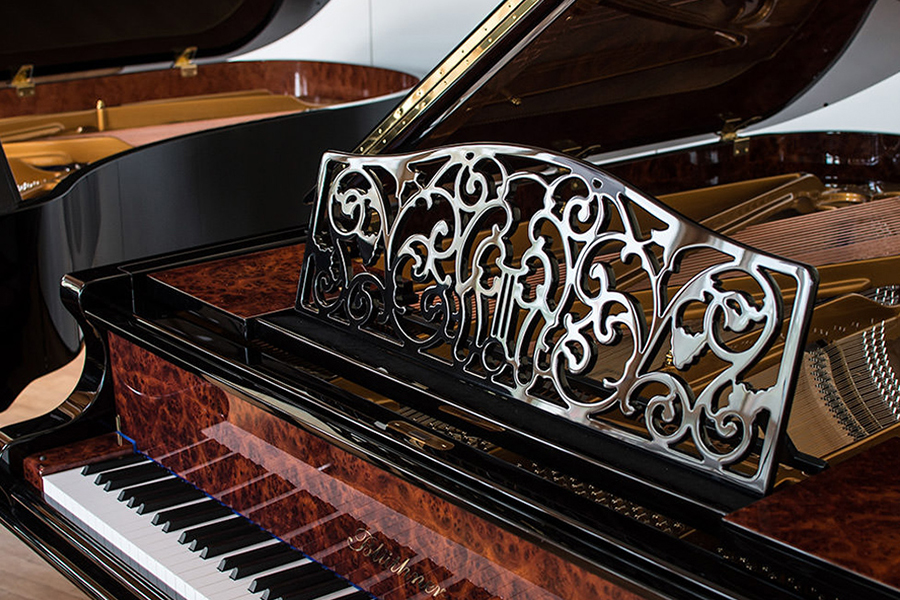
The top lids are manufactured in a special way to not only assure rigidity but to give an acoustical advantage. Wood stripping is glued side by side and sized to the proper thickness. Three layers of veneer applied to both sides make the structure light and resonant whether in the open or closed position.


[ Home ]

Blüthner Piano Centre Ltd.
1 Davies Street, Berkeley Square, Mayfair, London W1K 3DB
T. +44 (0)20 7753 0533    F. +44 (0)20 7753 0535
E. info@bluthner.co.uk   W. www.bluthner.co.uk

Non-Java Sitemap | Terms and Conditions | Copyright | Privacy Policy

Grand Pianos | Piano Repairs | Piano Servicing | Piano Shops in London | Piano Tuning and Repairs | Reconditioned Pianos

(c) 2004-2005 Blüthner Piano Centre Ltd