Click to return to home page www.bluthner.co.uk
The Manufacturing of a Blüthner


Aged wood being dried down to 6-8 percent in the kiln.

Manufacturing begins at the point when materials are selected and ordered. This is the time when special attention must be given to the choice of wood.

Hand picked cants and planks are stored and exposed to the natural elements for several years in order for the aging process to be complete and to reach a reduced humidity content of near 13 percent. Selection is again made with great care before it is again dried in Bliithner's own computer-controlled kilns. The moisture content is further reduced by approximately 0.15 percent each day until the level of 6 to 8 percent is reached as determined by the species of wood being dried.

Careful kiln drying will all but eliminate the wood's memory for further warping and tearing. The time factor here is also important. Drying too quickly may completely destroy the years long seasoning thus rendering the material unfit for piano making. Unlike large scale operations Blüthner takes the time to be sure these important drying procedures have been correctly maintained.

Re-sorting the materials marks the next phase of manufacturing. The species of woods for each individual component are laid out and then sawed and milled to size.

Some 4,500 individual parts and components that become a Blüthner piano are manufactured with an immense amount of effort. The components for piano backs and cases are assembled and glued and placed in giant presses until the glue has dried and seasoned 24 hours. Checking and re-checking this process assures a perfect assembly ready to accept the soundboard, which is then glued on. The soundboard has previously been made to order for the specific component.


Because the nature of the work is meticulous and very detailed the new instrument takes shape without haste. The wrest plank has been carefully fitted to the iron frame, dentist- like because of the critical nature of the exact fit needed.

Once more the frame is checked and milled for exactness to 1 millimetre before the next step towards completion that will take nearly another 50 hours.

Fitting the wrest plank


The back and inner case construction is assembled forming a solid foundation for the soundboard allowing it to reach its full capacity as a vibrating unit. The special Blüthner design guarantees that the soundboard will enhance the entire spectrum of sound that it receives from the vibrating strings.


A bass bridge being hand notched


Giant presses used to glue up the rim of a grand piano

The blank for a grand piano fall board is shown being precisely cut with a double blade circular saw.


Blüthner's precise methods of piano manufacturing using traditional means of production go hand in hand with their use of up-to-date machines. A visit to the Blüthner factory will prove this point. One can see hand craftsmanship enhanced by the use of these machines.

The highest degree of skill is required to install the Renner action. More than 6,000 individual parts are precisely fitted together to form a complex system of levers that when proper installed and adjusted will become an extension of the pianist's hands so that he or she can achieve complete touch control.

No compromise here, the technician is in command. Each part is carefully scrutinized, adjusted, tested, and adjusted again until satisfaction is achieved. Each hammerhead is measured, sized and checked for density, hand glued and balanced to the new action. Only the finest belong in a Blüthner action. The complete regulation processes are not carried out once or twice, but in three complete cycles. Each hammer is tone-voiced for evenness to bring out the ultimate beauty of tone of the Bluthner piano.


Gluing on hammerheads requires a great deal of experience and a good eye for exact alignment.


Driving tuning pins into the wrest plank

Polishing out a high polish surface demands a great deal of skill and endurance


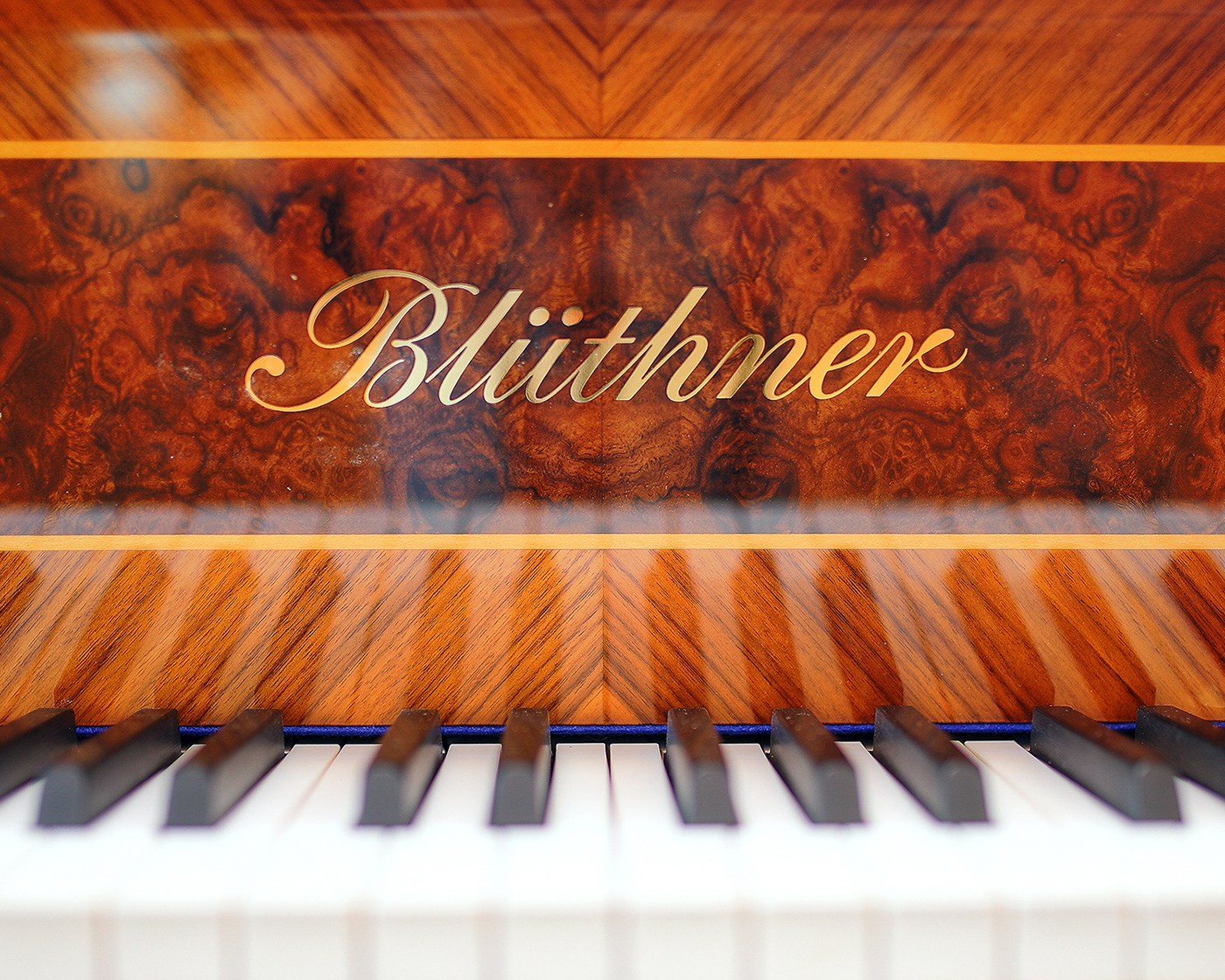
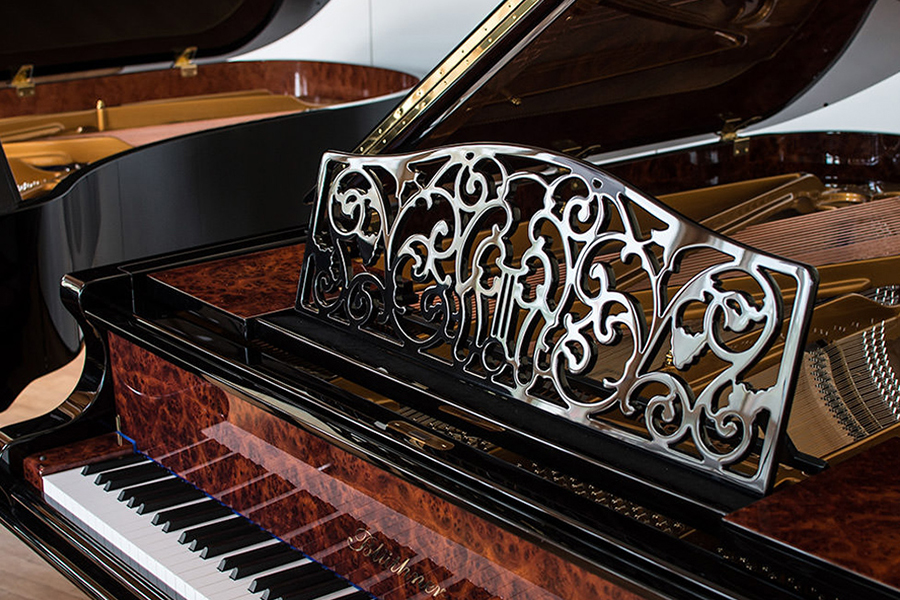
Each and every custom designed instrument is unique. Our customer's desires and needs are just as varied. Whether indigenous, exotic, or precious wood veneers are used or the instrument has combinations of veneers, lavish inlay work, gold plated Rococo style, leather inlay, traditional Wilhelminian style or the always in style elegant black mirror finish, they all have one common characteristic - the Blüthner sound.


[ Home ]

Blüthner Piano Centre Ltd.
1 Davies Street, Berkeley Square, Mayfair, London W1K 3DB
T. +44 (0)20 7753 0533    F. +44 (0)20 7753 0535
E. info@bluthner.co.uk   W. www.bluthner.co.uk

Non-Java Sitemap | Terms and Conditions | Copyright | Privacy Policy

Grand Pianos | Piano Repairs | Piano Servicing | Piano Shops in London | Piano Tuning and Repairs | Reconditioned Pianos

(c) 2004-2005 Blüthner Piano Centre Ltd